Alhambra sits in California Climate Zone 9, where summers run long and dry and afternoons regularly pass 95°F during heat waves. A cooling system here works more hours each year than almost any other part of the house.
Alhambra · Los Angeles County
HVAC & AC Repair Alhambra, CA
A system that runs but does not heat or cool is usually telling you where the fault is. Call and describe what it is doing, what it did before it stopped and how old the equipment is.
- No obligation to hire
- Describe the symptom in plain words
- Furnace, AC and duct questions welcome
Diagnostics
A diagnosis starts with a reading, not a guess
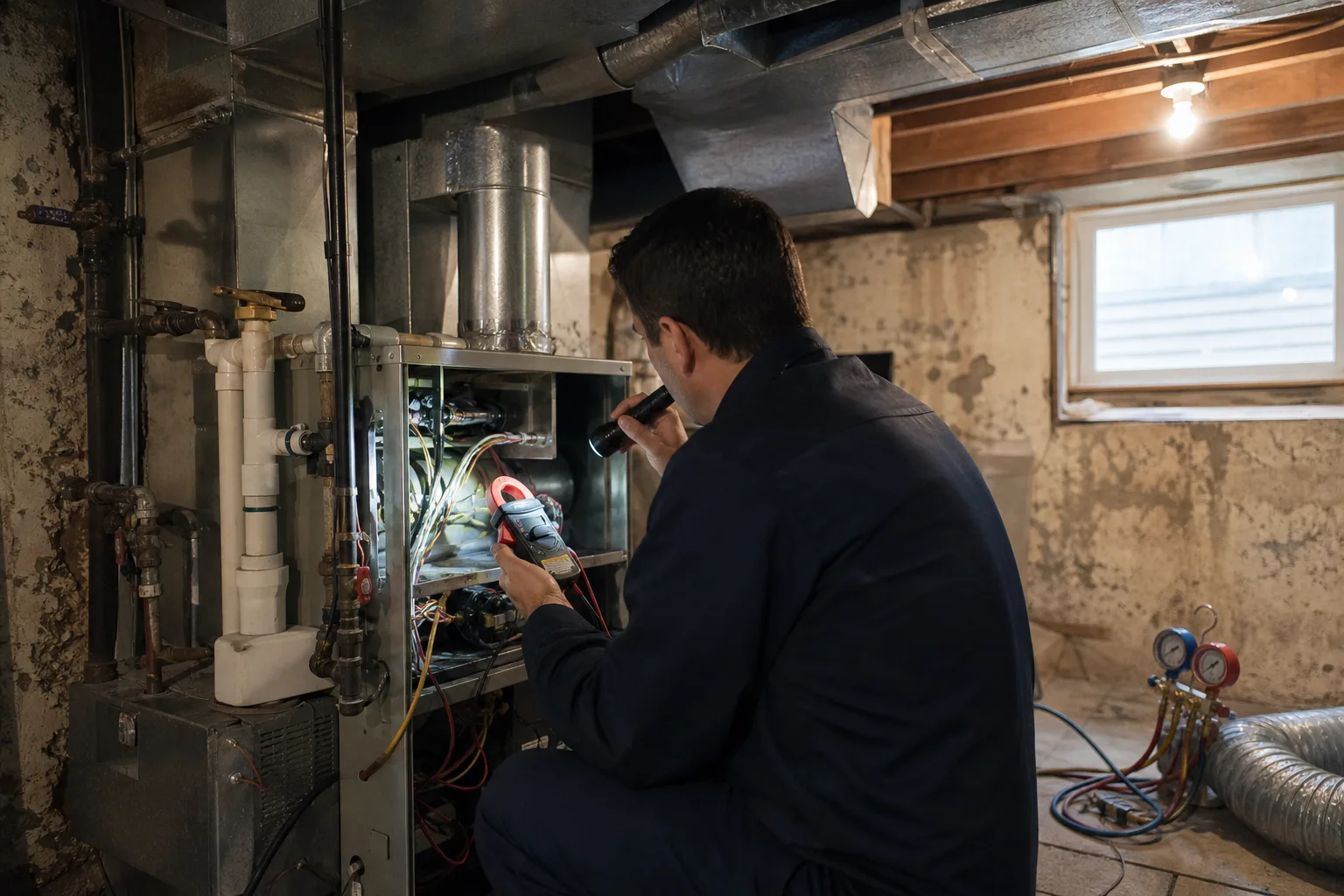
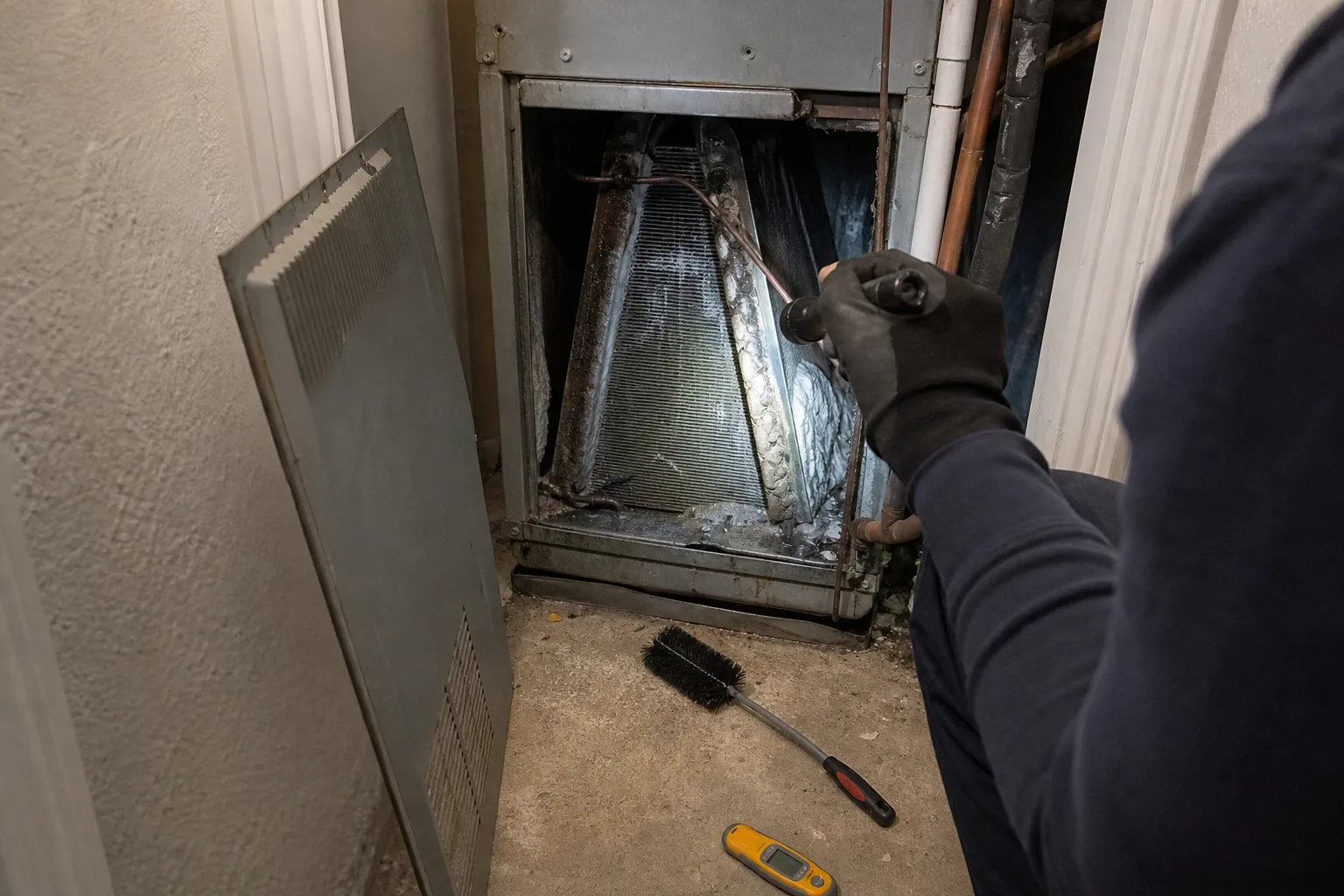
Temperature split, motor amperage, capacitor values and static pressure show where a system is losing capacity. Those readings come before any part is replaced, so the repair matches the fault.
- Cooling: the temperature split across the coil and the condenser current.
- Heating: the flame signal, the temperature rise and the flue gases.
- Airflow: static pressure and the air each register delivers.
How diagnosis works
Guesswork against a measurement-based diagnosis
The right-hand column describes how a fault is usually found and confirmed with instruments. The left shows what tends to happen when a system is run through the symptom or fixed by guessing.
| Stage | Delay or DIY hazard | Measurement-based diagnosis |
|---|---|---|
| The symptom | Running a struggling system through the symptom stresses the compressor and blower until a small fault becomes a large one. | The system is stopped, and the symptom, the age and the history of the equipment are written down first. |
| Finding the cause | Swapping parts until the problem disappears costs more than the fault and can hide the real cause. | Pressures, temperatures, airflow and electrical readings are compared with the equipment's normal range. |
| Refrigerant | Adding refrigerant to a low system without finding the leak repeats the cost and releases refrigerant. | The leak is located and repaired, then the system is evacuated and charged to the equipment's specification. |
| Gas and combustion | Relighting a furnace that shut itself off hides the safety fault it was reporting. | Combustion and venting are tested, and the heat exchanger is inspected before the appliance is returned to use. |
Diagnostics & symptoms
What a failing heating or cooling system looks like in an Alhambra home
Match what you notice to a card. Urgent means a safety sign or a fault that keeps getting worse; routine means the system underperforms but is safe to leave off while you call.
Urgent
Smell of gas or a carbon monoxide alarm
Leave the building first. Call the gas utility for a gas smell or 911 for an alarm, and do not switch anything on or off on the way out.
See the guide UrgentBurning smell, smoke or a tripping breaker
An electrical or overheating fault gets worse when it keeps running. Switch the system off at the thermostat and the breaker, then call.
See the guide UrgentIce on the lines or water around the indoor unit
A frozen coil melts into a drain pan that can overflow into ceilings and floors. Turn the cooling off so the ice can melt, and keep the fan running if the unit allows it.
See the guide RoutineThe air conditioner runs but the house stays warm
Low airflow, a dirty coil or low refrigerant can each cause it. Check the filter and the thermostat first, then describe what you find.
See the guide RoutineThe system turns on and off every few minutes
Short cycling wears out the compressor and the blower. It often traces back to airflow, an oversized system or a failing control.
See the guide RoutineSome rooms are hot or cold, or the registers barely move air
Leaking, crushed or disconnected ducts lose conditioned air before it reaches the room. The equipment can be fine while the delivery is not.
See the guideLocal standards
What shapes heating and cooling in Alhambra
Pre-1970s homes with attic ductwork
// Housing stockPermits, Title 24 and duct testing
// Housing stockCalifornia Energy Commission Climate Zone 9
// Climate and heatHot summers, cool winter nights
// Climate and heatI-5, I-605 and CA-60
// Main routes · across Los Angeles CountyWhy call
Why the first call matters in Alhambra
A heating or cooling fault rarely stays the same size. The sooner an Alhambra homeowner can describe what the system is doing, the sooner the right next step is clear.
- Professional HVAC work typically starts with measurements and follows the equipment manufacturer's specifications and the local mechanical code.
- Climate, the age of the equipment and how the ducts run through the building all shape how a system is loaded; the local sections below set out what has been verified.
- This page covers Alhambra and Los Angeles County; the service-area section lists the places and ZIP codes.
1
The right kind of help
Cooling, heating, heat pumps, ducts and maintenance each call for different diagnosis and different parts.
2
Local conditions
Heating and cooling load in Los Angeles County depends on local climate and construction, so those are set out below.
3
What to have ready
What the system is doing, what it did first and how old it is. That is enough to start the call.
Triage order
Five kinds of heating and cooling problems, and where each one starts
Nearly every comfort problem in an Alhambra home belongs to one of five groups, and knowing which group yours falls into shortens the path to a fix. This site organizes its guidance the same way.
- AC repair and replacement
No cooling, warm air, ice, water, noises, smells and central air conditioner replacement.
- Furnace repair and installation
No heat, no ignition, cold air, gas safety signs and furnace replacement.
- Heat pump services
Ducted heat pumps that fail in one mode, ice up or need replacement.
- Maintenance and tune-ups
Seasonal checks, short cycling, weak airflow and thermostat trouble.
- Ductwork repair and replacement
Leaking, disconnected or crushed ducts, and rooms that never match the thermostat.
Property type
Why Alhambra homes strain their systems in particular ways
Much of the housing is Craftsman and Spanish revival bungalows built before 1970, concentrated in ZIP codes 91801 and 91803. Their attics are shallow and hot, their closets are small, and the ducts are often a mix of original sheet metal and flexible duct added in later remodels.
- Heat waves
Weeks of 95°F afternoons wear run capacitors, contactors and compressors.
- Attic ducts
Temperatures above 100°F age tape, jackets and control boards.
- Older electrical service
Panels sized for a smaller house limit what a new system can draw.
How it works
What actually fails when a system quits in a heat wave
Most summer breakdowns come down to a short list of parts. The run capacitor stores the charge a compressor and fan need to start, and heat degrades it until the motor hums without turning. The contactor that switches the outdoor unit pits and sticks for the same reason.
Airflow problems follow close behind. A clogged filter, a matted coil or a crushed attic duct raises resistance, the evaporator freezes, and water or ice shows up where it should not. The pages on this site separate these causes so that the first description of the problem is already pointed in the right direction.
Describe what the system is doing, which rooms are affected and how old the home is, and the call can sort out the next step.
(626) 687-0603Technique
How a problem is diagnosed and the order the work follows
A diagnosis follows the path of the electricity and the air, from the simple to the involved. It relies on instruments, not on guesses.
Describe the symptom
Which mode, which rooms, how long and whether there is a sound, smell, ice or water.
Check power and controls
Thermostat, breakers, disconnects and the low-voltage signal.
Read the electrical parts
Capacitor values, contactor condition and motor amperage against ratings.
Measure airflow
Filter, blower, coil and the pressure the ducts place on the blower.
Test the sealed circuit
Pressures and temperatures, only after everything above has been ruled out.
Safety is settled first, then the cause is found, then the repair is made and measured. A simple electrical fault is replaced and tested in one visit.
Sealed-system work, such as a refrigerant leak or a reversing valve, takes longer because the circuit must be recovered, repaired, evacuated and charged by weight.
A replacement adds a permit, an installation and a duct verification to the sequence, and each step is accounted for before the system is considered finished.
Safety protocol
When a comfort problem is also a safety problem
A few symptoms take priority over comfort. A gas smell, a carbon monoxide alarm, smoke or a burning electrical odor means leaving the system alone and getting people out or the power off first.
- Gas odor
Leave the house, avoid switches and call the gas utility and 911 from outside.
- Carbon monoxide alarm
Go outdoors and call 911.
- Burning smell
Turn the system off at the breaker and leave it off.
- Heat illness
Confusion, a rapid pulse or hot dry skin is a medical emergency.
Measured results
How a finished repair is proven
- Temperature split
Cooling shows a clear difference between return and supply air.
- Motor amperage
Each motor draws current at or below its nameplate rating.
- Flame signal and carbon monoxide
A furnace shows a strong flame signal and safe flue readings.
- Both modes
A heat pump heats and cools, shifts cleanly and clears frost on its own.
- Rooms
Temperatures across the house sit close together once the ducts are sound.
Documentation
Which jobs need a City of Alhambra permit under Title 24
Repairs and tune-ups generally need no permit. Replacing a central air conditioner, a furnace or a heat pump, or altering the ducts, is regulated work under California's Title 24 energy code, permitted through the City of Alhambra Building Division.
On a replacement the installing technician normally pulls the permit, and a third-party rater verifies duct leakage and airflow before it closes. Ask who is responsible for each step before agreeing to the work. Scope and pricing are agreed directly with the independent technician.
Triage order
Repair, replace or compare: how the larger decisions are framed
Most calls end in a repair, but some end in a bigger question. A failed compressor, a cracked heat exchanger or a third repair in a single season moves the conversation toward replacement, and the guides on this site set out the signals in plain terms.
- System age
Past fifteen years most components are close to the end of their life.
- Which part failed
A capacitor is routine, while a compressor or a heat exchanger often decides the outcome.
- Duct condition
New equipment connected to failing ducts repeats the same poor results.
- Electrical capacity
A heat pump with electric strips has to fit the panel, and an older panel may need work first.
How it works
Why the ducts decide whether new equipment performs
Equipment moves heat, but ducts deliver it. A system of any age loses a large share of its output when joints separate, runs collapse or returns are too small, and the loss is largest in attics that sit above 100°F in summer.
For that reason a service call often ends with a look at the attic. Repairing a boot, supporting a sagging run or sealing a seam with mastic can change a house more than a new outdoor unit would, and a leakage test turns the result into a number.
Property type
Where this applies: Alhambra ZIP codes 91801, 91803 and 91804
This site covers homes in Alhambra, California, in ZIP codes 91801, 91803 and 91804, within Los Angeles County. It addresses residential, ducted systems: central air conditioners, gas furnaces, ducted heat pumps and the ductwork that serves them.
Pick the group that matches your symptom, read the page for your situation and call with the details it asks for. The more precisely the problem is described, the more direct the next step.
Local housing
How Alhambra buildings are heated and cooled
Pre-1970s homes with attic ductwork
// Housing stockMuch of Alhambra's housing is single-family homes built before 1970, many with ducts that run through the attic.
Aged attic ducts leak and lose heating and cooling into the attic, so the system runs longer for less comfort and some rooms never catch up.
Say how old the home is and whether the ducts run through the attic, and ask for the ducts to be checked along with the equipment.
Permits, Title 24 and duct testing
// Housing stockCalifornia's Title 24 energy standards apply to HVAC replacements. A mechanical permit is pulled through the City of Alhambra Building Division, 111 S. First St., and major replacements require HERS duct-leakage verification.
A major replacement without the permit and the duct-leakage test can be flagged at inspection, and the work may have to be reopened.
Before agreeing to a replacement, ask who pulls the mechanical permit and who arranges the HERS duct test.
Climate & heat
Heat, air quality and weather around Alhambra
California Energy Commission Climate Zone 9
// Climate and heatAlhambra sits in California Energy Commission Climate Zone 9, the San Gabriel Valley basin.
Zone 9 has long, hot summers and short, cool winters, so cooling is the dominant load: the air conditioner runs the most hours of the year, and the furnace or heat pump carries the shorter heating season.
Say whether the problem shows up in cooling or heating mode, and how many hours a day the system has been running.
Hot summers, cool winter nights
// Climate and heatSummer afternoons in Alhambra commonly peak between about 88°F and 98°F, and higher in a heat wave, while winter lows fall to about 44°F to 47°F.
Long runs at peak heat load the compressor, capacitor and condenser fan, so wear tends to show up as warm air or a tripped breaker on the hottest days, and cool winter nights still ask the furnace or heat pump for repeated short runs.
Note the outdoor temperature when the problem started, and say whether the system ran continuously before it failed.
Service area
Serving Alhambra & Los Angeles County
Coverage
Covered ZIP codes (3): 91801, 91803, 91804
- I-5, I-605 and CA-60: I-5, I-605 (the San Gabriel River Freeway) and CA-60 are major arterials through Los Angeles County.
Congestion or a closure on one of them lengthens the route to a property, so the nearest cross street and exit matter more than the street address alone.
Give the nearest cross street or freeway exit when you call.
Not sure your address is inside the coverage area? Call and give your ZIP code.
Questions
Alhambra heating and cooling — FAQ
What should I check before calling about an HVAC problem in Alhambra?
Check that the thermostat is set to the right mode and has working batteries, that the filter is not clogged and that the breaker has not tripped. Note what the system is doing, what it did first and how old it is, and describe that when you call.
What do I do if I smell gas or a carbon monoxide alarm sounds?
Leave the building. Call the gas utility from outside for a gas smell, or call 911 if a carbon monoxide alarm sounds or anyone feels unwell. Do not switch appliances or lights on or off on the way out.
Why does my air conditioner blow warm air or freeze over?
Restricted airflow from a dirty filter or coil is the most common cause of a frozen coil, and low refrigerant from a leak is another. Warm air with the fan running can also point to a failed outdoor fan, capacitor or compressor. Turn cooling off if you see ice, and call to describe it.
Should I repair or replace an older system?
It depends on the age of the equipment, the cost of the repair and how often it has failed. When a repair is large and the equipment is near the end of its life, replacing it becomes the practical question. Describe the system and its history when you call.
What areas does this page cover?
Alhambra and the surrounding Los Angeles County area.
Is there a cost to call?
A call costs nothing and does not commit you to hiring anyone. Any cost for a visit or a repair is something you would discuss directly with the contractor.
A heating or cooling fault rarely fixes itself.
Call and describe the problem in Alhambra: what the system is doing, what it did first and how old the equipment is.