Measurement comes first, repairs come second and proof comes last. A system with a few disconnected boots is sealed and secured, while one with collapsed or deteriorated runs moves to replacement of the failed sections or the whole network.
Service category · Alhambra, CA
Ductwork Repair and Replacement in Alhambra, CA
The ducts are the part of a heating and cooling system that nobody sees and everybody depends on. In Alhambra's older bungalows they run through hot attics, and when they leak, sag or collapse, new equipment and careful maintenance cannot fix the rooms that stay uncomfortable.
What you are seeing
How a failing duct system shows itself
- Hot and cold rooms
One bedroom never cools while another is too cold, even with the thermostat satisfied.
- Constant running
The system runs most of the afternoon to reach a setpoint it used to hold easily.
- Dust and attic odor
Return leaks pull attic air, insulation fibers and dust into the living space.
- Whistling or rumbling
Air forced through a pinched or leaking section makes noise.
- Stains and sweating
Condensation or dirt streaks around a register or a ceiling boot.
How it works
What ducts do, and what leaks take away
Supply ducts carry conditioned air from the equipment to each room, and return ducts bring room air back. Both sections work as one pressurized loop, so a leak anywhere sends air where it should not go.
- Supply leaks
Cooled or heated air escapes into the attic, and the room receives less than the equipment produced.
- Return leaks
The blower draws hot, dusty attic air into the system, which raises the load on the coil.
- Restrictions
Kinks, crushed sections and undersized runs choke the flow to a room.
- Disconnections
A boot or takeoff that separates dumps the whole branch into the attic.
Property type
Original sheet metal and later flex in Craftsman and Spanish revival attics
Alhambra bungalows in 91801 and 91803 were built with sheet-metal ducts or none at all, and cooling arrived decades later. The ducts in many of these attics are a patchwork of original metal, flexible duct added in later remodels and tape that has dried out.
- Added rooms
Additions sit at the end of long, thin runs that were never meant to feed them.
- Attic heat
Temperatures above 100°F bake tape adhesive and flex jackets.
- Tight framing
Low roofs leave little room, so flex duct is bent, compressed or draped over joists.
Technique
How a duct system is evaluated
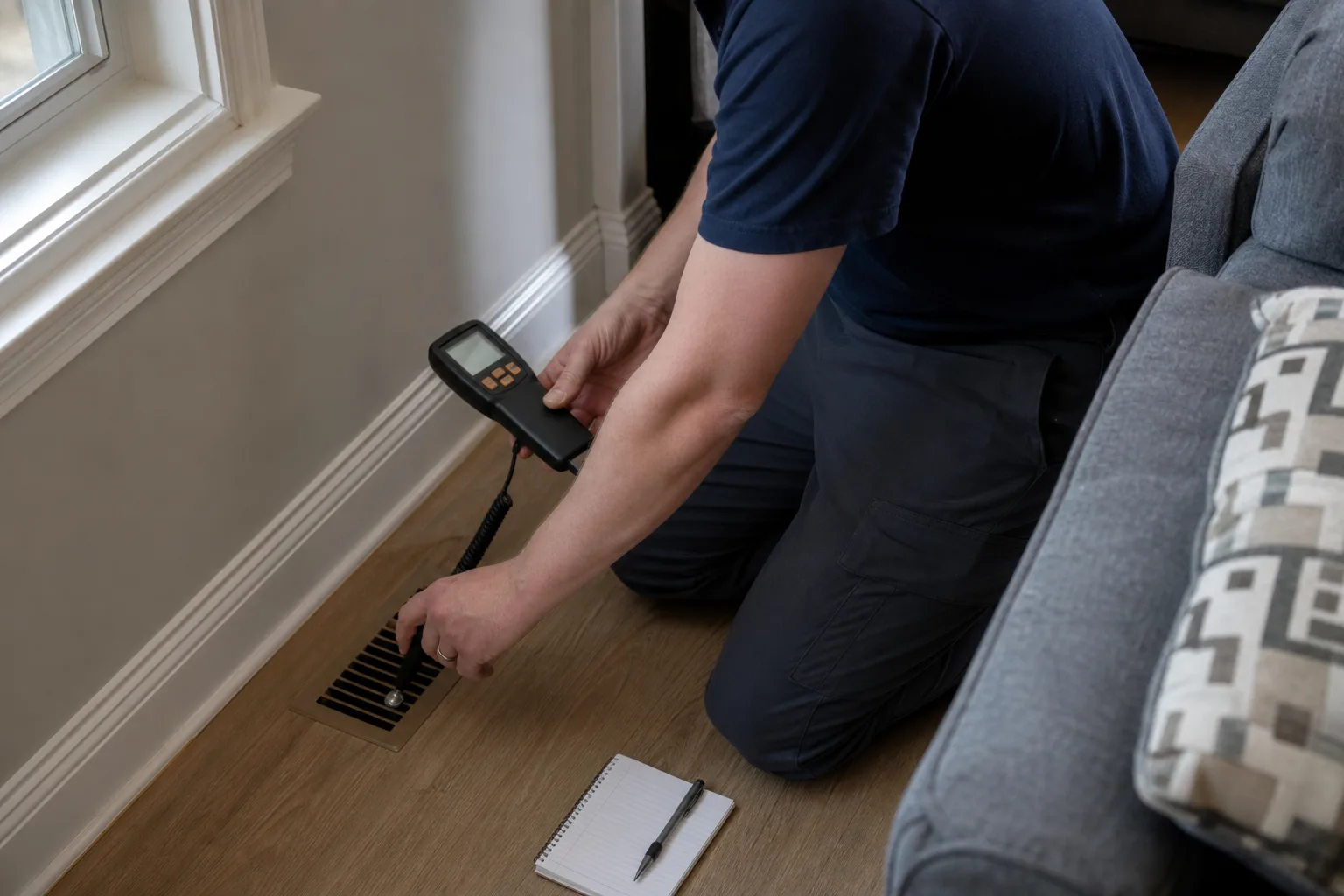
A duct problem is measured, not guessed. The attic is walked from the equipment outward, and instruments quantify what the eye cannot.
Trace the runs
Each supply and return branch is followed for tears, separations, kinks and sagging.
Static pressure
The blower's resistance shows whether restrictions are present.
Register airflow
Air volume at each register is compared with what the room needs.
Leakage test
The system is pressurized and the leak rate is measured.
Insulation check
Jackets and wrap are examined for gaps, wet spots and wear.
A pressure pan is a simple test: a pan placed over a register measures how much pressure the branch is holding. A low reading marks a leaking branch, which tells the technician where to look first.
Tell the call which rooms are uncomfortable and whether the ducts run through the attic, and it can point you to the right next step.
(626) 687-0603Phase order
The order of duct work
Because attic work is slow and hot in summer, ductwork is best planned for the cooler months, when the attic is safer to work in and the house makes lighter demands on the system, which also leaves room for a permit and a rater.
Triage order
Seal, repair or replace: choosing a page
The pages below cover leaking and disconnected ducts, whole-system sealing and testing, crushed runs, uneven rooms and ductwork replacement. Each explains what is measured and what the work involves.
- Seal
Joints and seams are closed with mastic and fastened mechanically.
- Repair
Disconnected, torn or sagging sections are reattached, patched or supported.
- Replace
Runs that are collapsed, deteriorated or worn beyond repair are removed and replaced.
Choose your situation
Ductwork repair and replacement, by situation
- Leaking or Disconnected DuctsBoots, collars and joints that have come apart in the attic, and how they are found and refastened.
- Ductwork ReplacementWhen attic ducts are beyond repair, what replacement involves and how the new system is sealed and tested.
- Hot and Cold Rooms From Duct ProblemsRooms that never match the thermostat: long runs, leaks, weak returns and how airflow is balanced.
- Duct Sealing and LeakageHow duct leakage is measured, why mastic outlasts tape, and how a Title 24 rater verifies a sealed system.
- Collapsed or Crushed DuctsFlattened, kinked or sagging ducts: what flattens them and how sections are replaced and supported.
Measured results
What finished duct work should measure
- Leakage
The pressurized test shows the leak rate has fallen within the code limit.
- Airflow
Each room receives air close to its intended volume.
- Static pressure
The blower faces a resistance inside its rated range.
- Rooms
Temperatures across the house sit closer together.
Local detail
Attic ducts and Climate Zone 9 heat
In California Climate Zone 9, a duct in an Alhambra attic can sit in air hotter than the day outside. A leak there sends cooled air into that heat and pulls the heat back in, so a duct problem in Los Angeles County does the most harm on the hottest days.
Documentation
Title 24 duct testing and the City of Alhambra Building Division
Sealing a boot or reattaching a run is repair work, but replacing or altering ducts brings California's Title 24 into play.
Leakage and airflow must then be verified by a third-party rater before the permit closes, and the City of Alhambra Building Division issues the permit. Ask the technician who pulls the permit and who arranges the rater before the work begins.
Safety protocol
Staying safe around attic ducts
- Stay out of the attic in summer
Heat above 100°F can cause heat illness within minutes of exposure.
- Stay on the framing
Ceiling drywall and insulation will not hold a person's weight.
- Leave old wrapped joints alone
Insulation and tape from older decades can contain asbestos, and disturbing it releases fibers.
How it works
Duct materials and how each one fails
The materials in an attic tell the technician what to expect. Each has a characteristic way of failing.
- Sheet metal
Seams open and tape or mastic dries out, and the metal itself rusts in damp locations.
- Flexible duct
The inner liner collapses when kinked, the outer jacket tears and the wire helix pulls away from the collar.
- Duct board
Fiberglass board loses its facing and sags between supports.
- Fittings and boots
Connections separate where straps have loosened or sealant has failed.
Scope: Emergency diagnostic dispatch, whole system replacement and ductwork replacement only. Scope and pricing are provided directly by independent licensed contractors.
Common questions
Ductwork questions from Alhambra homeowners
Which Alhambra ZIP codes does ductwork guidance cover?
This site covers Alhambra homes in ZIP codes 91801, 91803 and 91804, within Los Angeles County.
How do I know if my ducts are leaking?
Hot and cold rooms, a system that runs constantly and dust at the registers are signs. A pressurized leakage test measures it.
Does replacing ducts need a permit in Alhambra?
Altering or replacing ducts is permitted through the City of Alhambra Building Division, and Title 24 requires leakage and airflow to be verified by a third-party rater.
Can ducts be repaired instead of replaced?
Often yes. Sealing and reattaching sound runs is a repair, while collapsed or deteriorated sections are replaced.
What should I say when I call about ductwork?
Name the rooms that are too hot or cold, say whether the ducts run through the attic and mention any dust, noise or stains. The age of the home and of any additions helps too.
A heating or cooling fault rarely fixes itself.
Call and describe the problem in Alhambra: what the system is doing, what it did first and how old the equipment is.