Safety comes first: gas smell and carbon monoxide are cleared before any repair starts. The sequence then follows the furnace itself, from the thermostat and power to the igniter, flame sensor and venting.
Service category · Alhambra, CA
Heating / Furnace Repair and Installation in Alhambra, CA
Alhambra winters are short and mild, so a furnace spends most of the year idle and then has to work on the first cold morning. That pattern, not heavy use, explains most heating failures here, and this page sorts them so the call starts with the right facts.
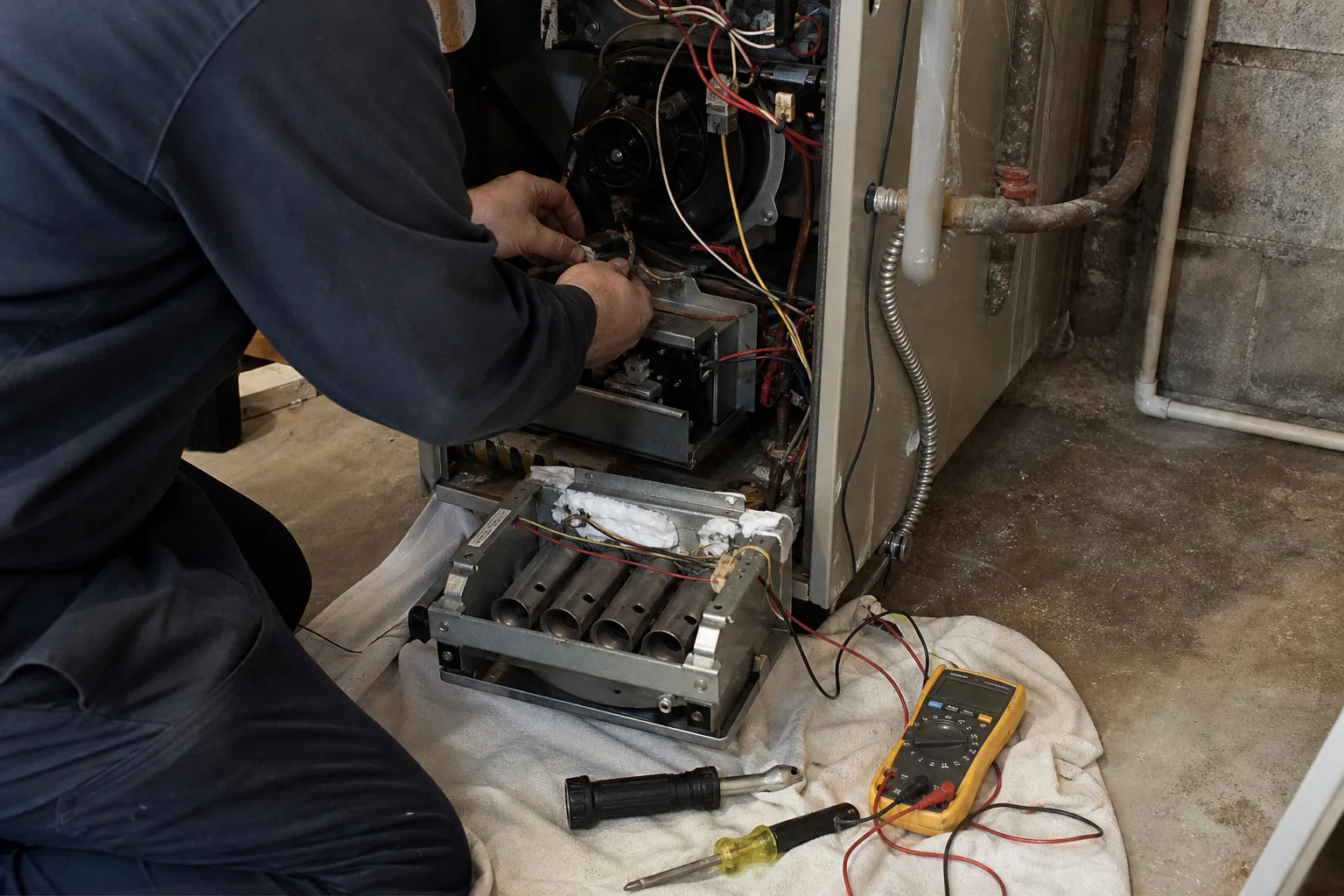
What you are seeing
Four heating problems and what each one means
- No heat at all
The thermostat calls, but the furnace never lights, so the fault sits in the start-up sequence.
- Heat that starts and stops
A furnace that lights, runs briefly and shuts down is usually protecting itself from overheating or a weak flame signal.
- Cold air from the vents
The blower is running without a flame behind it, or the ducts are losing heat before it arrives.
- Bangs, whistles or rumbles
A new furnace sound belongs to the draft inducer, the burners or the blower.
How it works
The sequence a gas furnace must complete before heat arrives
A modern gas furnace does not simply light. It runs a checked sequence, and any step that fails sends it into a safety lockout instead of heat.
Call for heat
The thermostat closes a low-voltage circuit and the control board wakes.
Draft inducer
A small fan starts to pull combustion gases through the heat exchanger and out the flue.
Pressure switch
The switch proves the draft is real before the board allows gas to flow.
Igniter and gas valve
A hot surface igniter glows, then the gas valve opens and the burners light.
Flame sensor
A thin rod must sense the flame within seconds or the valve closes again.
Blower delay
The blower starts only after the heat exchanger warms, so the first air is not cold.
Two protective devices sit outside that sequence. A high-limit switch shuts the burners if the heat exchanger overheats, and a flame rollout switch trips if flame escapes the burner box. Either one stopping the furnace is a warning that airflow or combustion has gone wrong, not a part to bypass.
Property type
Hall-closet furnaces, wall units and the long idle summer
Many older Alhambra homes in ZIP codes 91801 and 91803 heat from a furnace in a hall closet or the attic, and some still rely on a wall or floor heater from the original construction. These units sit unused from spring through autumn, collecting dust on the igniter and the flame sensor.
- Dust and film
A thin coating on the flame sensor is the most common reason a furnace lights and then shuts off.
- Cracked igniters
Silicon igniters weaken with age and fail on the first cold start.
- Tight closets
Little combustion air makes burners run poorly and traps heat around the controls.
Technique
How a no-heat call is diagnosed
A technician reads the furnace in the order it runs, because the lockout code shows where the sequence stopped. The control board usually records the last few faults as flashes on a small light.
Read the fault code
The board light pattern names the circuit that failed.
Check the gas supply
The shutoff valve is open and the supply reaches the valve.
Test the igniter
Resistance and glow are compared with the part's rating.
Clean and test the flame sensor
Microamp readings show whether the flame signal is strong enough.
Examine the venting
The flue, the inducer and the pressure switch hose are checked for blockage.
Describe what the furnace does when the thermostat calls for heat, and the call can point you to the right next step.
(626) 687-0603Phase order
The order of work from the first call to a warm house
The cause is corrected, the furnace is run through a full heating cycle, and the readings above are recorded. A replacement adds a permit, the installation and the duct verification to that order.
Triage order
Repair, replace or install: where to go next
Most furnace failures are small parts, and a replacement is warranted only when the heat exchanger itself has failed or the unit is near the end of its life. The pages below cover each situation in detail, including how a furnace replacement is installed and permitted.
- Heat exchanger condition
A cracked or rusted exchanger can leak combustion gas into the airstream and ends the repair discussion.
- Furnace age
Past about fifteen to twenty years, igniters, boards and inducers tend to fail one after another.
- Repair history
Several no-heat calls in two winters suggest the unit is wearing out as a whole.
- Cooling compatibility
The furnace houses the blower that also serves the air conditioner, so its replacement affects cooling.
Choose your situation
Furnace repair and installation, by situation
- Furnace Not HeatingThe thermostat calls but the house stays cold: lockouts, the igniter, the flame sensor and the gas supply.
- Furnace Repair or ReplaceHeat exchanger condition, age, repair history and venting: how the furnace decision is made.
- Furnace InstallationHow a gas furnace replacement is set, vented, connected and tested, with the permit steps.
- Gas Furnace Safety SignsCarbon monoxide alarms, gas odor, yellow flame, soot and rollout: what each sign means and what to do.
- Furnace Blowing Cold AirCool air from the vents while the furnace runs: blower delay, lost flame, limit switches and duct loss.
- Furnace Not IgnitingClicking, glowing or silent igniter with no burner flame: igniters, gas valves, pressure switches and pilots.
- Furnace Making NoisesBanging, whistling, rattling, squealing and ticking from the furnace: which are normal and which need attention.
Measured results
What a finished furnace repair should measure
- Temperature rise
Supply air runs within the range printed on the furnace nameplate above the return air.
- Flame signal
The sensor reads a stable microamp value, well above the lockout threshold.
- Clean combustion
The flame is steady and blue, with no rollout or sooting.
- Complete cycle
The furnace runs through a full heating call and shuts down on the thermostat.
Local detail
Cold snaps after a mild autumn in Alhambra
Winter lows in Alhambra, Los Angeles County, fall into the mid forties, so the first cold night often arrives before anyone has tested the furnace. A system that has sat idle for months is most likely to fail exactly when the household first needs it.
Documentation
Permits and Title 24 for furnace replacement
Swapping an igniter, sensor or control board needs no permit. Replacing a furnace is regulated work: California's Title 24 energy code applies, and the change is permitted through the City of Alhambra Building Division.
The permit is normally pulled by the installing technician. When ducts are altered, the duct leakage must also be verified by a third-party rater before the permit closes.
Safety protocol
When a heating problem becomes a safety problem
- Gas smell
Leave the house, avoid switches, and call the gas utility and 911 from outside.
- Carbon monoxide alarm
Go outdoors, call 911, and do not re-enter until it is cleared.
- Soot or yellow flame
Switch the furnace off at the thermostat and the breaker.
- Repeated relighting
Leave it off if a pilot or igniter keeps failing.
Scope: Emergency diagnostic dispatch, whole system replacement and ductwork replacement only. Scope and pricing are provided directly by independent licensed contractors.
Common questions
Furnace questions from Alhambra homeowners
Which Alhambra ZIP codes does furnace guidance cover?
This site covers Alhambra homes in ZIP codes 91801, 91803 and 91804, within Los Angeles County.
Why does a furnace fail on the first cold night?
After months of sitting idle, dust coats the flame sensor and the igniter weakens, so the first start is the hardest. Alhambra's mild winters make this the usual failure.
Is a furnace that clicks but never lights dangerous?
It is safe to leave off, and it should be. Repeated attempts can collect unburned gas, so a technician should find the cause.
Does replacing a furnace need a permit in Alhambra?
Yes. A furnace replacement is permitted through the City of Alhambra Building Division and is subject to California's Title 24 energy standards.
A heating or cooling fault rarely fixes itself.
Call and describe the problem in Alhambra: what the system is doing, what it did first and how old the equipment is.