Alhambra sits in California Climate Zone 9, where long dry summers regularly push afternoons past 95°F. A residential condenser is sized for a design day, and a heat wave stacks several days beyond it, so the compressor runs almost continuously against high head pressure.
Service category · Alhambra, CA
AC Repair and Central AC Replacement in Alhambra, CA
In Alhambra, the air conditioner is the hardest-working appliance in the house, and when it quits during a heat wave the cause is usually one of a short list of failures. This page sorts those failures, explains how a repair is diagnosed and measured, and points to the page that matches what your system is doing.
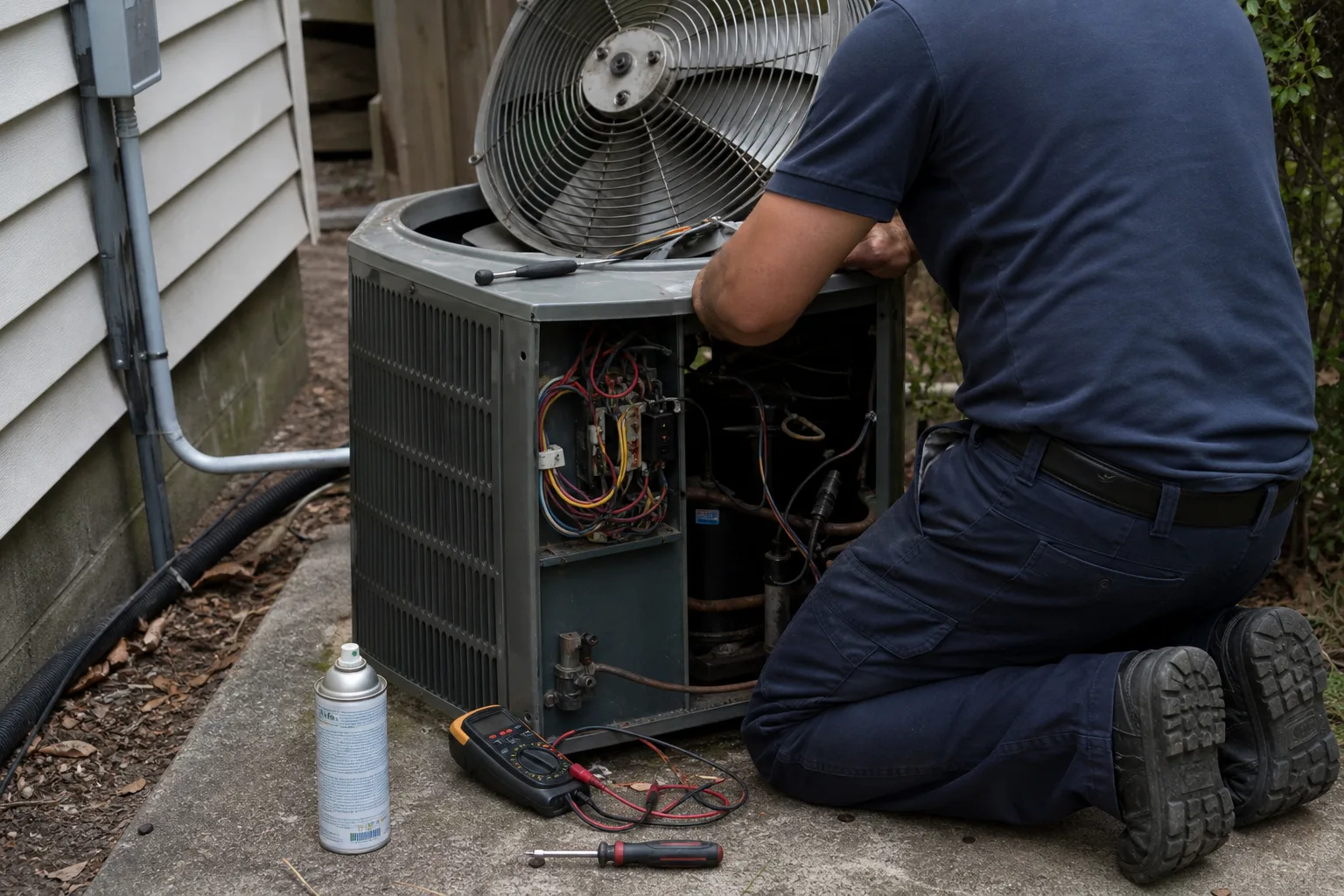
What you are seeing
Five symptoms that tell you what failed
- Blowing warm air
The blower runs but the air at the vent is close to room temperature, which points to a compressor, capacitor or refrigerant-circuit fault.
- Will not start
A dark thermostat display, a silent outdoor unit or a breaker that keeps tripping each separates a power fault from a control fault.
- Ice or water
A frosted refrigerant line or a stained ceiling means airflow or drainage has failed, and running the system longer makes the problem worse.
- Grinding, buzzing or banging
Each sound belongs to a different moving part, from the blower wheel to the compressor mounts.
- Burning or musty odor
An electrical smell means shut the system off, while a damp smell points at the drain pan and the evaporator coil.
How it works
Why late-summer heat in Climate Zone 9 breaks the same parts
That load is hardest on the run capacitor, which stores the charge the compressor and fan motors need to start. Heat degrades its internal film, its capacity drifts below the rated microfarads, and the motor hums without turning.
- Run capacitor
Weakens with heat and age and is the most common cause of a unit that hums but will not start.
- Contactor
Its contacts burn after thousands of heavy starts, so the outdoor unit stays off or will not shut off.
- Condenser fan motor
Slows or seizes, so the coil cannot shed heat and the compressor trips on its overload.
- Compressor
Fails last, and is the failure most likely to change the repair-or-replace decision.
Property type
Craftsman and Spanish revival bungalows in 91801 and 91803
Much of Alhambra's housing stock predates 1970: Craftsman and Spanish revival bungalows with shallow attics, small utility closets and equipment added decades after the house was framed. The ducts are where this shows.
Original sheet-metal runs were patched or replaced with flexible duct over the years, and in an attic that climbs well past 100°F in summer, the flex sags, tears at the boots and gets crushed under stored boxes.
- Attic flex duct
Kinked or disconnected runs spill cooled air into the attic and starve the farthest bedrooms.
- Undersized returns
A single hallway return starves the blower, which can ice the coil and shorten motor life.
Technique
How an AC repair call is diagnosed
A diagnostic works from the simplest, most likely cause toward the least likely, and it relies on meter readings instead of guesses. The order below is the usual path a technician follows.
Controls and power
Thermostat settings and batteries, breaker position, the disconnect at the outdoor unit and the low-voltage signal reaching the contactor.
Electrical readings
Capacitor microfarads, contactor voltage and the amperage drawn by the compressor and fan motors, each compared with its nameplate.
Airflow and drainage
Filter condition, blower speed, coil face, condensate line and the static pressure the ducts place on the blower.
Refrigerant circuit
Gauge readings and line temperatures show whether the circuit has lost charge. A leak is located and repaired by a technician and is never a homeowner task.
Describe what the system is doing and where it is failing, and the call can point you to the right next step.
(626) 687-0603Triage order
Repair or replace: five questions that settle it
- System age
Past fifteen years most components are near the end of their life, and one failure is often followed closely by another.
- Which part failed
A capacitor or contactor is a routine repair, while a seized compressor often tips the decision.
- Repeat failures
Two or three repairs in one summer suggest the system is wearing out as a whole.
- Refrigerant type
Older R-22 systems use a refrigerant that is no longer produced, which narrows the repair options.
- Duct condition
New equipment connected to failing ducts repeats the same poor results.
The pages listed below work through these questions. The independent technician sizes and scopes any replacement on site.
Choose your situation
AC repair and replacement, by situation
- AC Not Cooling / Blowing Warm AirThe fan runs but the air is warm: the outdoor unit, the capacitor, a dirty coil or a lost refrigerant charge.
- AC Not Turning onNo display, a silent outdoor unit or a tripping breaker: tracing the power and control chain.
- Frozen AC Coil / AC Leaking WaterIce on the line, a wet ceiling or a drain pan overflow: airflow, charge and drainage causes.
- Emergency AC RepairWhen an AC failure in a heat wave is urgent, how to stay safe meanwhile, and what is checked first.
- Central AC ReplacementWhat a full central AC replacement includes, the Title 24 permit steps and the duct test in Alhambra.
- Repair or Replace: How to DecideA decision guide: age, failed part, repeat repairs, refrigerant type and duct condition.
- AC Making NoisesBuzzing, rattling, squealing, grinding or hissing: what each noise points to and when to shut the system off.
- AC Compressor Not StartingHumming or clicking without a start: the capacitor, overload, voltage and compressor windings.
- AC SmellsMusty, burning, gas-like or chemical odors from the vents: what each means and which ones are urgent.
Measured results
What a finished repair should show on the meter
- Temperature split
Return and supply air differ by roughly 16 to 22°F across the coil on a normal day.
- Amp draw
Compressor and fan amperage sit at or below the rated load on the nameplate.
- Drain flow
The condensate line carries water freely and the drain pan stays dry.
Local detail
Alhambra heat and older electrical service
Many Alhambra homes in Los Angeles County pair long attic duct runs with older electrical panels, so an AC that has tripped its breaker twice is showing a fault, not a nuisance. When you call, give the ZIP code and the age of the home.
Documentation
Title 24, permits and the City of Alhambra Building Division
Repairs such as a capacitor, contactor or motor swap usually need no permit, but replacing a system is regulated work. California's Title 24 energy code governs equipment efficiency, duct sealing and airflow, and replacements are permitted through the City of Alhambra Building Division.
On a replacement the permit is normally pulled by the installing technician, and a third-party rater verifies duct leakage and airflow before the permit is closed. Ask who is responsible for each step before agreeing to the work.
Safety protocol
Before the technician arrives: what to do and what to leave alone
- Switch to Off
Set the thermostat to Off if the unit runs without cooling, so a struggling compressor is not forced to keep trying.
- Breaker
If ice, water or a burning odor is present, turn the system breaker off and leave it off.
- Panels stay closed
Capacitors hold a charge after the power is off, so access panels are for technicians only.
- Refrigerant lines
Never touch or loosen them, because refrigerant work is federally regulated.
- Heat safety
Move children, older relatives and pets to the coolest room.
Scope: Emergency diagnostic dispatch, whole system replacement and ductwork replacement only. Scope and pricing are provided directly by independent licensed contractors.
Common questions
AC repair questions from Alhambra homeowners
Which Alhambra ZIP codes does this cover?
This site covers Alhambra homes in ZIP codes 91801, 91803 and 91804, within Los Angeles County.
Does a heat wave make AC failures more likely?
Yes. Several days above 95°F keep the compressor under high pressure and wear the run capacitor, which is why failures cluster during heat waves in Alhambra.
Should I keep running an AC that blows warm air?
It is better to switch it off. A unit that runs without cooling can overheat the compressor or freeze the coil, and either one turns a small repair into a large one.
Is a permit needed to replace a central AC in Alhambra?
A full replacement is permitted work under California's Title 24 through the City of Alhambra Building Division. Ask the technician who pulls the permit before you agree to the work.
A heating or cooling fault rarely fixes itself.
Call and describe the problem in Alhambra: what the system is doing, what it did first and how old the equipment is.