A compressor motor needs a burst of torque to start against the pressure left in the circuit. The capacitor supplies that torque by shifting the electrical phase in a winding, and without it the rotor draws locked-rotor current and does not turn.
Service · Alhambra, CA
AC Compressor Not Starting in Alhambra, CA
When the outdoor unit hums or clicks but the compressor never turns, the motor is asking for a push that the start components cannot deliver. In most cases the compressor itself is fine, and the fault is in the parts that help it start.
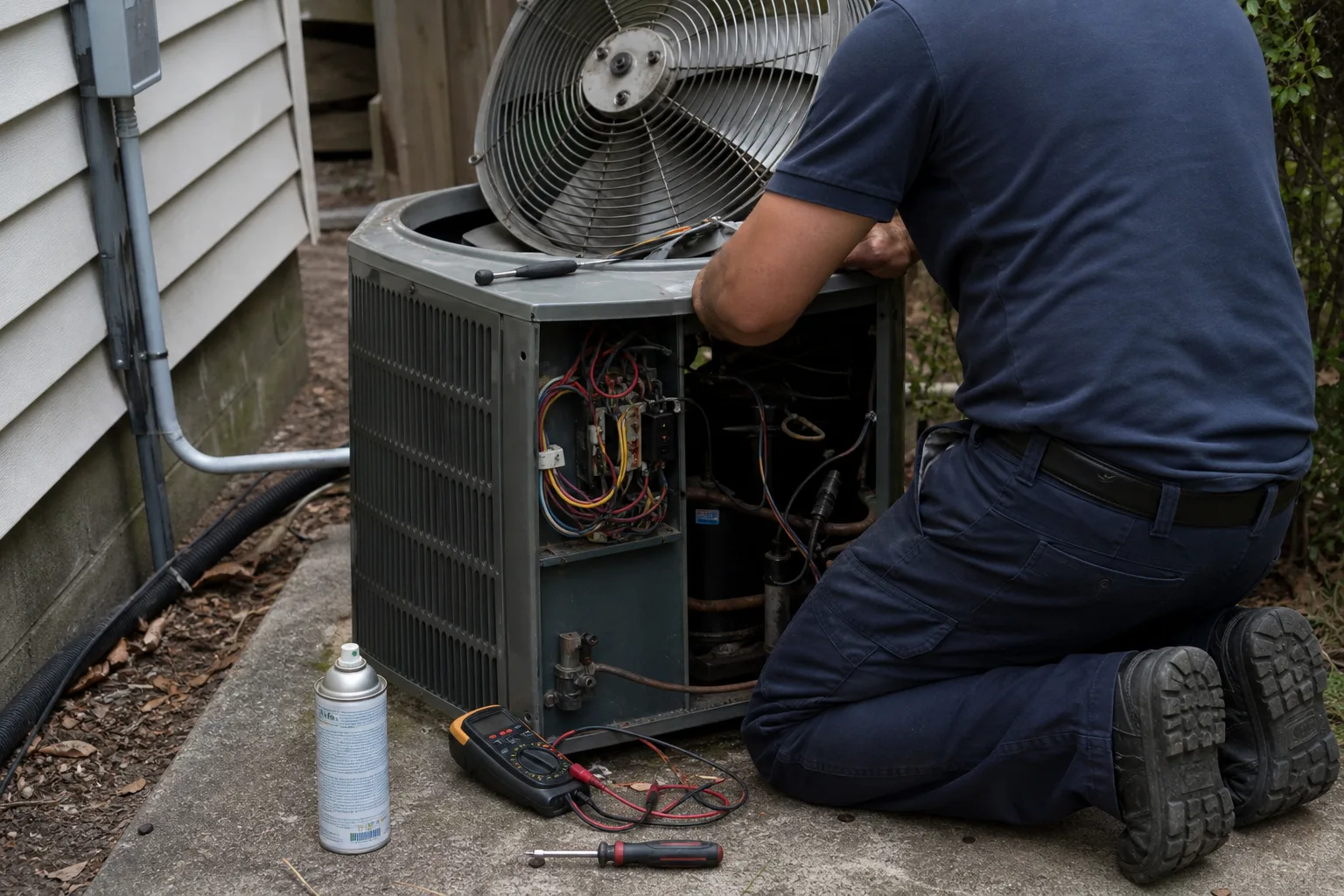
What you are seeing
What a compressor that will not start sounds like
- Hum with no spin
The outdoor fan may turn, but the compressor only buzzes and the unit shuts down.
- Click, then silence
The contactor pulls in and the compressor's internal overload opens almost at once.
- Starts only sometimes
The unit runs on cool mornings and fails on hot afternoons.
How it works
Locked-rotor current and what a capacitor contributes
That current is several times the running current and heats the winding rapidly. An internal thermal overload opens to protect the motor and resets only after it cools, which is why a hot compressor can seem to start and stop on its own.
Property type
Summer voltage and older service panels
Sustained voltage drop on a hot evening, when neighbors' air conditioners are running too, can leave a marginal compressor short of starting torque. Older meter panels and long runs to a side-yard disconnect add resistance to the same circuit.
- Loose lugs
A warm or discolored terminal at the disconnect robs the compressor of voltage.
- Aged wiring
Brittle insulation in an older whip raises resistance and heat.
Technique
How a no-start compressor is tested
Voltage at the unit
Line voltage measured under load, to rule out a voltage drop.
Capacitor
Rated microfarads against the measured value, within tolerance.
Contactor
Contact condition and coil pull-in.
Winding resistance
Ohm readings between terminals to find an open or shorted winding.
Ground test
Insulation resistance to the case, to find a winding that has shorted to ground.
Amperage at start
Locked-rotor current compared with the nameplate.
Tell the call whether the outdoor unit hums, clicks or stays silent, and whether the fan spins, and it can narrow the fault.
(626) 687-0603Phase order
Start parts first, compressor last
The order moves from the simplest part to the most involved. A capacitor, a contactor and a corroded connection are cleared first, and only when each tests sound is the compressor itself judged.
A start-assist component may be added by a technician when a healthy compressor on an older system struggles to start in extreme heat.
Local detail
Hot evenings and starting torque
In Alhambra, the hour after sunset in a heat wave is often when a compressor with a weak capacitor finally refuses to start, because attic and ground temperatures are still high. Los Angeles County utility demand peaks at the same hours.
Safety protocol
Why repeated restart attempts do harm
- Heat buildup
Each failed start sends locked-rotor current through the winding.
- Breaker fatigue
Repeated trips wear the breaker and heat the wiring.
- Panel stays closed
A capacitor can hold a charge after power is off.
Measured results
What a healthy start looks like
A repaired compressor starts on the first call, with the fan and compressor turning together and no pause between the click and the hum.
- Running amperage
Current falls to the nameplate rating within seconds of the start.
- Capacitor value
Measured microfarads sit inside the tolerance printed on the can.
- Winding insulation
A megohm reading to ground shows the winding is still intact.
Triage order
When the compressor itself has failed
If the windings read open, shorted or grounded, no start component will revive the compressor. Replacing a scroll compressor is a sealed-system job, because the circuit must be recovered, repaired, evacuated and charged by weight.
On an older condenser that job often opens the repair-or-replace conversation, and the homeowner and the independent technician decide together what makes sense.
Scope: Emergency diagnostic dispatch, whole system replacement and ductwork replacement only. Scope and pricing are provided directly by independent licensed contractors.
Common questions
Questions about a compressor that will not start in Alhambra
Is no-start diagnosis offered across 91801, 91803 and 91804?
This guidance covers Alhambra homes in ZIP codes 91801, 91803 and 91804.
Does a humming compressor always mean it has failed?
No. A weak run capacitor is far more common, and a capacitor is a small part compared with a compressor.
Can the compressor reset itself?
Yes. Its internal overload opens when the winding overheats and closes again after it cools, which can make the fault seem to come and go.
Is it safe to keep pressing the thermostat?
No. Each failed start sends current surges through the winding, and repeated attempts can burn it.
A heating or cooling fault rarely fixes itself.
Call and describe the problem in Alhambra: what the system is doing, what it did first and how old the equipment is.